Vault Info
An overview of automated strategy vaults on Derive
Delta-1 Basis Vaults
Earn yield with an automated delta-1 basis trade
Delta-1 Basis Strategy
An overview of the potential benefits and risks to participating in the Delta-1 Basis Strategy
How does the Delta-1 Basis Strategy work?
The delta-1 basis strategy enables holders of LSTs/LRTs to keep full exposure to the base asset (e.g., LBTC/weETH) while earning yield from perp funding spreads.
To achieve this, the vault borrows USDC to buy more of the base asset (up to 2x), while hedging away the excess exposure via short perps to remain delta-1.
How does it differ from the Ethena Basis Strategy?
The underlying yield strategy is very similar: the deposited sUSDe is used to buy spot ETH/BTC, while shorting an equal amount of perps. The main difference is that sUSDe holders have no exposure to any price movements in ETH/BTC (i.e., delta neutral).
Components of the automated Delta-1 Basis Strategy
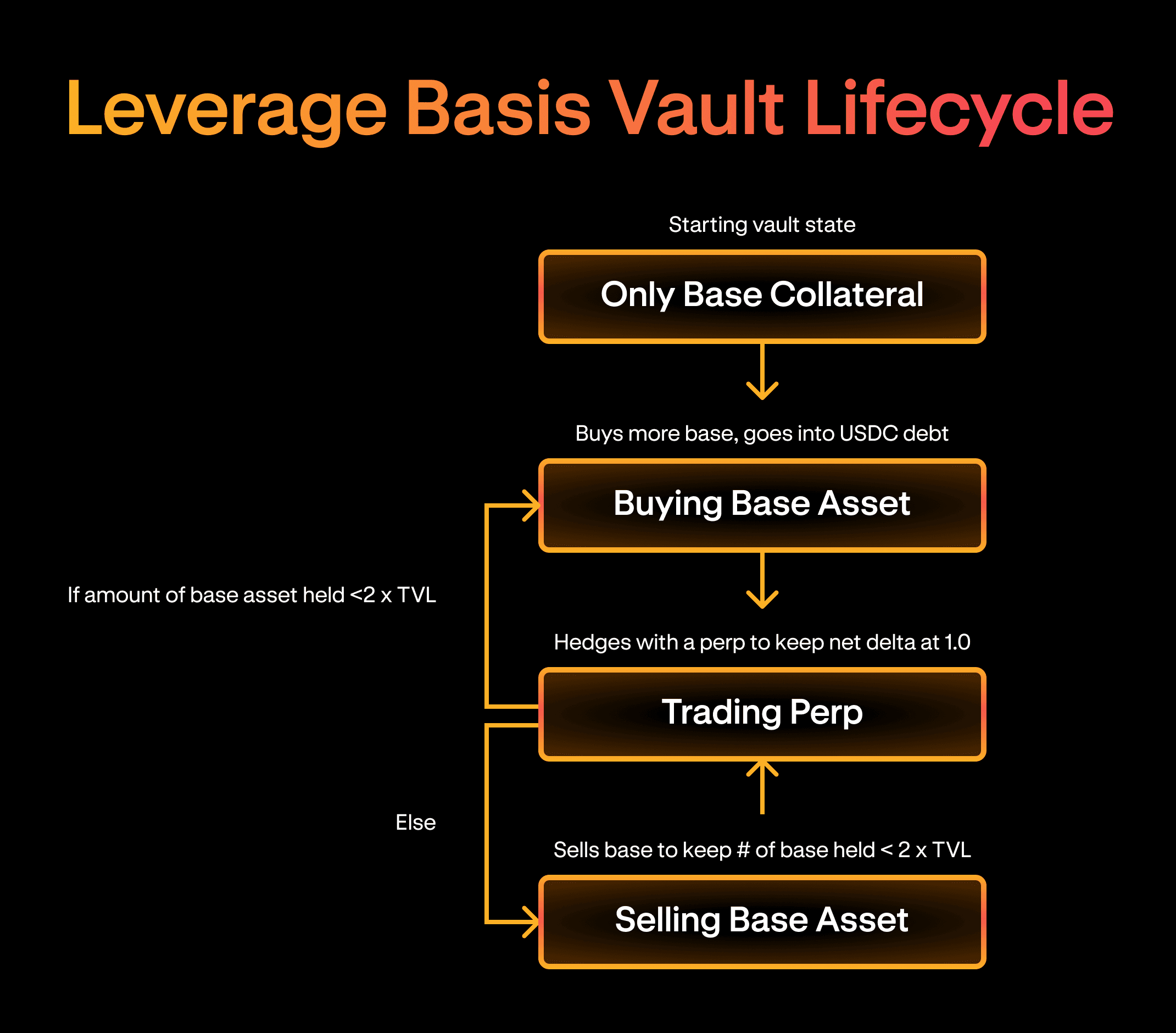
The 5 components of the automated delta-1 basis strategy are illustrated by the following example:
1 - Deposit
An LBTC holder deposits 1 LBTC (worth 100,000 USDC) into the vault as collateral.
2 - Leverage
The vault borrows 100,000 USDC against the base asset it holds to buy an additional 1 LBTC, targeting a leverage ratio of 2x. As a result, the vault now holds 2 LBTC and 100,000 USDC debt.
3 - Hedge
Immediately after buying the additional 1 LBTC on the spot market, the vault hedges the excess exposure by shorting 1 BTC-PERP. The vault now has a net delta of 1.0.
4 - Earn
The vault is now earning Lombard points on 2 LBTC, staking yield on 2 LBTC, Derive trading rewards, and yield from the perp funding spread, while paying a borrow rate on the 100,000 USDC debt.
5 - Adjust
If the funding rate or borrowing costs shift unfavorably, the vault reverses steps #2 and #3 until it holds 1 LBTC, 0 USDC debt, and 0 short perp exposure.
*Note that the vault executes steps #2 and #3 in small sizes to ensure good pricing.
Who should participate in the strategy?
The delta-1 basis strategy is best suited for current and future holders of the supported LSTs/LRTs (e.g., LBTC/weETH).
Participating in the strategy enables holders to keep full exposure to price movements in the base asset (e.g., LBTC/weETH), earn LST/LRT points and staking yield (up to 2x), while also collecting perp funding spreads.
What are the risks of the strategy?
Notably, although the vault borrows USDC, it will not be liquidated, even if the price of BTC increases 10x or drops by 99%. This is because the gains on one leg offset the losses on the other. However, there is liquidation risk in the event of a large LST/LRT depeg.
The main risk of the strategy is an unfavorable shift in the funding rate and borrowing costs (i.e., funding rate < borrowing costs), in particular when there is low spot or perp liquidity. In a situation like this, the vault may take longer to exit the trade and could result in short periods of negative carry.
Yield calculation
The combination of a delta-1 basis strategy with yield-bearing LSTs/LRTs (e.g., LBTC/weETH), unlocks new sources of yield. The calculation is as follows:
APY: (up to 2x * Base Asset APY) + Funding Rate APY - Borrow Rate APY
Points: (up to 2x * LST/LRT points) + Derive rewards
Delta-1 Basis Execution
Delta-1 Basis Risks
Harvest Vaults
Harvest Strategy
An overview of the potential benefits and risks to participating in the Covered Call Strategy
TLDR
Covered Call Tokens allow users to participate in a Covered Call options strategy.
The Covered Call strategy effectively allows holders of the underlying asset to commit to a limit sell order, at a higher price, for a period of time (via selling call options), in return for yield on their asset.
The key risk to selling covered calls is that asset holders miss out on price appreciation of their asset, beyond the strike price of the option.
Covered Call writing is best suited for neutral-to-bullish market conditions. On the upside, profit potential is limited, and on the downside there is the full risk of holding the asset below the strike.
What is a covered call?
A covered call is a simple trading strategy with two components:
An asset that you own
A short call option on the same or similar asset, using the asset itself as collateral
In return, covered call sellers receive yield via USDC premiums.
A call option has two key dimensions to consider for covered call execution:
Its strike: the price which the option buyer can purchase the asset from you
Its expiration: the date on which the option buyer can buy the asset, for the strike price
Changing these parameters affects the yield generated by the option.
Higher strike = lower yield (you are committing to selling the asset at a higher, or worse, price)
Shorter expiry = lower yield* (you are committing to selling the asset for a shorter period, which is less optionality and value for the buyer)
*However if you ‘roll’ the strategy by executing weekly, the yields are generally higher (with higher risk) for shorter dated rolling strategies.
Why would I sell covered calls?
Selling covered calls boils down to pre-committing to limit sell orders, and getting paid for it. In return, you sacrifice upside if the price of the asset you’re trading rapidly increases. The annualized yield afforded by selling covered calls typically ranges from 10-50% on the collateral posted.
Covered calls are generally best for:
Medium to large size holders of the underlying asset
Interested in generating cash flows
Who are targeting a sell price that is above the current price
The downside of the strategy is two-fold:
You stand to miss out on upside if the price goes up, quickly
You remain exposed to the downside if the asset loses value
Derive Covered Call Tokens are designed to:
Sell weekly upside calls (with a roughly 10-15% chance of expiring in the money)
Collateralized with the same or similar asset
It is important users consult the up-to-date information on yield and points programs in the app before entering a strategy, as these are subject to change.
Example
Alan sells 100 covered calls using rswETH as collateral.
ETH is trading at $3,000
Alan has 100 rswETH (Swell’s native restaking token), worth $300,000
Alan deposits 100 rsWETH into Derive's tokenized strategy, and mints Restaked Swell ETH Covered Call tokens (rswETHC)
The Covered Call Strategy executes a trade which sells 100 ETH $3,500 calls for $10 each, expiring in 7 days
There are two possible scenarios where the outcome differs between selling covered calls and simply holding the underlying asset.
Scenario 1
ETH finishes the 7 day period at $3,400.
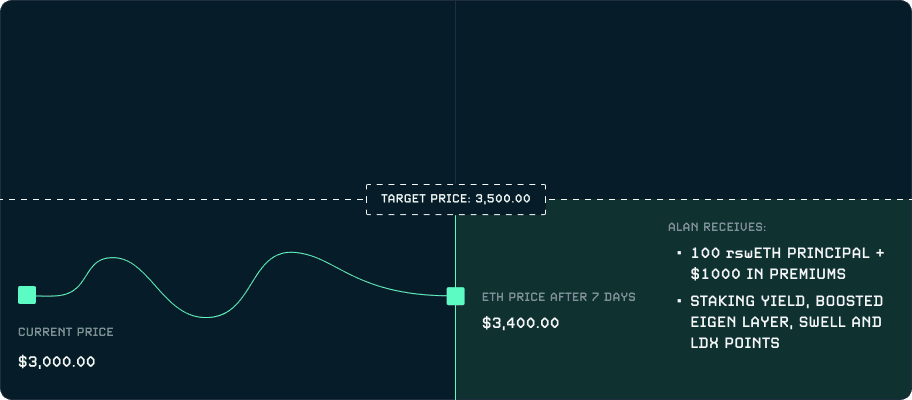
When ETH finishes at or below $3,500, Alan earns more than he would have had he not used the strategy.
Earnings breakdown:
100% of the principal (100 rswETH)
$1,000 in premium income ($50,000 / year = 20% annualized)
$60 in staked ETH yield ($3,000 / year = 3% annualized)
EigenLayer points, boosted Swell points and DRV points (30 points per hour per ETH; uncapped deposit limit)
Scenario 2
ETH finishes the 7 day period at $3,600.

Harvest Execution

1. Only Collateral
The vault launches with only its collateral. If the vault collects option premiums and cannot sell the received USDC into its collateral due to low liquidity, the vault might also proceed to the next stage with a small amount of positive USDC balance (to be explained in stage 4).
2. Option Limit Order Auction
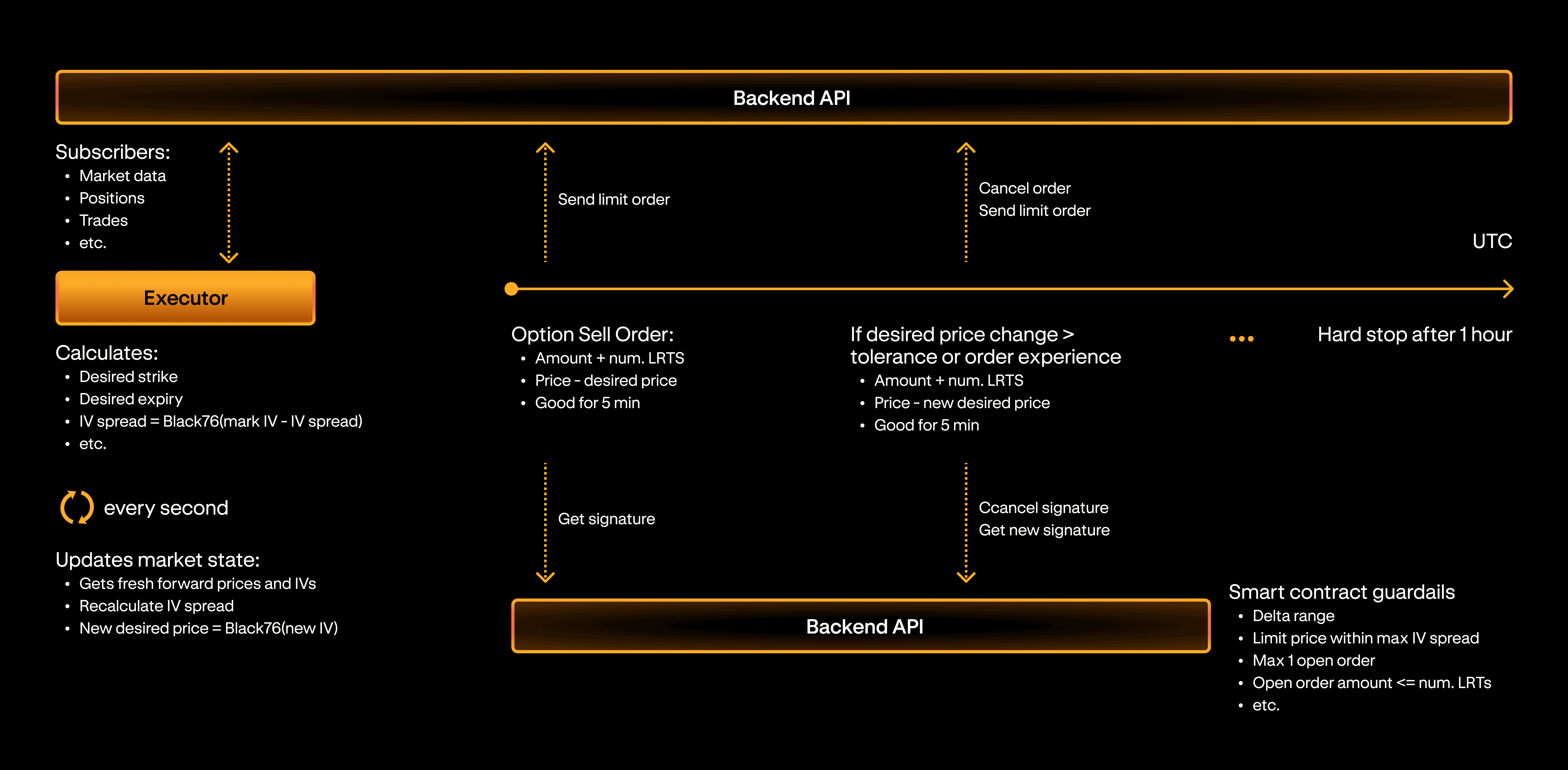
The vault begins to execute a “limit order auction” to sell options.
Select an option from the desired expiry and delta range.
The executor uses the orderbook API to find the option of the target DTE that is closest to its target delta
The signing smart contract will validate that the DTE and delta of the option are within range
Calculate
desired_pricefor this option. This is based on the forward price and volatility feeds from Block Scholes, and usesBlack76formula.Obtain a signature from the smart contract signer.
Send a sell limit order with the
limit_price = desired_priceandamount = number of LRTs.Market makers or any other retail user can trade against this order via the UI or orderbook API.
Every second, recalculate
desired_priceusing fresh feeds and add a small negative spread to the implied volatility,iv_spread = - iv_spread_per_sec x (now - auction_start_sec). The spread is capped atmax_iv_spread, and the volatility has a floor ofmin_iv.If desired price has changed by more than
option_price_change_tolerance, cancel the old order, request a new signature, and send out a new order using the newdesired_priceandamount = number of LRTs - number of filled options.Stop if
number of filled options = number of LRTs.Hard stop when
(now - auction_start_sec)exceeds somemax_option_auction_sec, e.g. 1 hour.
3. Await Option Settlement
After the order is fully filled or the hard stop has been reached, the executor will sleep until the option is expired and settled. After a settlement has been confirmed, the executor proceeds to stage 4.
4. Collateral Limit Order Auction
Note that if the option expired out-of-the-money, the vault will have positive USDC balance it acquired due from the premiums received in stage 2. If the option expired ITM, the USDC balance can be positive or negative depending on if the premiums were enough to cover the settlement loss.
The vault then begins to execute a “limit order auction” to buy or sell enough collateral to get rid of any USDC balance and bring itself back to stage 1.
Calculate
desired_pricefor the underlying spot asset - this is based on the spot price oracle.Calculate
desired_amount = num of USDC / desired_price. For example if the vault has $6,000 USDC and the LRT price is $3,000, the vault will attempt to buy 2 LRTs. Alternatively if the vault has $30,000 USDC debt due to an option that expired ITM, it will attempt to sell 10 LRTs.Obtain a signature from the smart contract signer.
Send a limit order with the
limit_price = desired_priceandamount = abs(desired_amount). The order is a buy order ifdesired_amount > 0, otherwise it’s a sell order.Every second, recalculate
desired_priceusing fresh feeds and add a small spread to the price (if buying) or subtract the spread (if selling). The spread is calculated asspot_spread = spot_spread_per_sec x (now - auction_start_sec), subject to amax_spot_spread.If desired price has changed by more than
spot_price_change_tolerance, cancel the old order, request a new signature, and send out a new order using the newdesired_priceanddesired_amount = remaining num of USDC / desired_price.Stop if
desired_amount = 0.If USDC balance is positive, hard stop when
(now - auction_start_sec)exceeds somemax_spot_auction_sec, e.g. 15 min. Note that it is possible for the auction to terminate and proceed back to stage 1 with some leftover USDC balance. If USDC balance is negative, the auction will continue indefinitely until the debt is repaid.
Smart Contract Strategy Mandate Enforcement
The subaccount owned by the vault is registered with the Derive Exchange in the same way as a regular user, with the core difference being in the way the order signing is performed
Derive ensures full custody of users’ funds by requiring (at a smart contract level) that any trade between two parties has messages signed by their session keys. A session key is just a separate private / public key pair that the user gives trading permissions by registering it with Derive's matching smart contract.
For example, in order for a trade between Alice and Bob to take place (e.g. to sells 8 call options at a price of $12.5), both Alice and Bob must sign a messages where they agree for such a trade, and both messages will be validated by the matching smart contract. Only the Exchange is allowed to submit such messages to the smart contract, which allows for added layers of security such as IP whitelisting of session keys, etc.
A vault has to go through the same flow, except the session keys it uses are not just plain old private keys stored somewhere secretly. Instead, the vault’s session key is a smart contract, and signatures are generated by calling this contract’s function.
The contract will only generate a signature if a set of validations passes, for example it will check the requested order’s amount against the collateral position the vault holds and refuses to generate a signature if the amount requested is too large. Similarly it will refuse to sign a price if that price is too far away from an oracle price. The set of validations that the signer will run are as follows:
Ensure option delta and expiry are within a certain range.
Ensure that at most one signed order can be open at any time.
Ensure that no option order can be signed if USDC balance is negative.
Ensure that the amount in the option order does not exceed its collateral position.
Ensure that the amount of the spot order does not exceed what’s required to clear the USDC balance.
Ensure the option limit price is higher than a threshold (calculated using oracle volatility and forward prices with a spread and a floor applied to the volatility).
Ensure that the spot limit price is within a range from the oracle mark price.
Ensure that the order signature will expire in < 10 min.
This set of rules guarantees that the vault executor cannot trade outside of the vault’s strategy mandate, and it protects the vault shareholders from badly priced trades being placed. At the same time, the off-chain components of the strategy (such as being able to cancel an open order when the price moves to avoid being picked off) enhances the execution quality.
Harvest Risks
Outlining key implementation risks of Covered Call Tokens
There are a few risks associated with tokenized strategies - beyond the risk of the strategy itself (detailed here). It is important users are aware of these risks before depositing to or acquiring a tokenized strategy. Note that this is not necessarily an exhaustive list.
Execution Risks
Delayed settlement
If options expire in-the-money, collateral will need to be swapped for USDC on settlement. Available spot liquidity on the exchange and the amount of collateral to be liquidated could factor in to longer settlement times, in order to ensure quality of execution.
Oracle Risk
Per the Derive docs, for each market, there is a set of oracle inputs used for marking assets when computing margin and liquidations. This data is posted onchain for transparency and available via the public REST API. This data is provided by Block Scholes.
It’s possible that feeds for certain assets (particularly less liquid ones) may have marks that deviate from the true fair value, which can result in suboptimal execution for the strategy vault.
Underlying Collateral Risk
Holding the underlying collateral carries its own set of risks. These may include, but are not limited to, smart contract bugs, Ethereum bugs, restaking penalties, price fluctuations, and key management problems.
For a detailed overview of the risks specific to each type of collateral, please refer to the relevant documentation:
LBTC Collateral:
Lombard's documentation & Babylon's documentation.
LRT Collateral:
EtherFi's documentation.
Swell's documentation.
Bridge Risk
Transferring assets from one network to another carries risks associated with the underlying bridge provider. In this product, we use Socket as the bridge provider. Please review their documentation for more details.
Smart Contract Risk
Interacting with any smart contract carries the risk of losing access to your funds. The immutable nature of smart contacts makes it difficult and potentially impossible to recover them.
Safe Harvest Strategy
An overview of the potential benefits and risks to participating in the Covered Call Spread Strategy.
TLDR
Earn yield on the underlying collateral in "trending up", sideways or bear markets.
The Covered Call Spread Strategy is a less risky alternative to the regular Covered Call Strategy.
This strategy is best suited for those who are holding the underlying asset and are comfortable with the risks of regular covered calls, but are concerned with giving up upside potential in the event of a large rally.
For an overview of the key implementation risks, please refer to Covered Call Spread Risks.
What is a Covered Call Spread Strategy?
A covered call spread combines a regular covered call with a higher-strike long call to limit the risk of missing out on potential upside from holding the underlying asset.
The automated Covered Call Spread Strategy consists of three components:
Deposit the underlying asset as collateral into the vault.
Each week, the Vault will:
Sell out-of-the-money call options to earn yield; and
Buy further out-of-the-money call options to limit risk.
After expiry, the Vault will either buy or sell collateral:
If the options payoff plus the net premium received results in a positive USDC balance, the Vault will use the USDC to buy collateral.
If the options payoff plus the net premium received results in a negative USDC balance, the Vault will sell collateral to clear the USDC debt.
Covered Call Spreads vs. Covered Calls
Regular covered calls forego all upside potential of holding the underlying collateral once the price of the asset reaches a certain point. For example, if the price of ETH is $2,600 and a weETH covered call has a $3,000 strike, the position stops appreciating in dollar terms once the price of ETH reaches $3,000. This means that if ETH rallies from $2,600 to $3,600 in one week, the holder would only earn $400 in profit, missing out on on the $600 gain from the increase between $3,000 and $3,600.
Covered call spreads limit the potential missed upside for the holder. By buying a long call option with a $3,100 strike, the holder can capture all ETH gains between $2,600 and $3,600, except for the portion between $3,000 and $3,100. This way, the holder would make a $900 profit and miss out on only $100 of the potential gains, compared to missing $600 with a regular covered call.
This comes at the cost of losing a percentage of the options premiums' APY. The USDC yield from the options premiums gets reduced by approximately half.
Example
Alan sells 100 covered calls using weETH as collateral.
ETH is trading at $2,600
Alan has 100 weETH, worth approximately $260,000
Alan deposits 100 weETH into the Covered Call Spread Strategy and mints weETHCS tokens
The Covered Call Spread Strategy executes a trade which sells 100 ETH $3,000 calls for $10 each, expiring in 7 days, as well as buys 100 ETH $3,100 calls for $4 each, netting a total of $600 worth of premiums paid to Alan.
There are three possible scenarios where the outcome differs between selling covered call spreads and simply holding the underlying asset.
Scenario 1
ETH finishes the 7 day period at or below $3,000. When ETH finishes at or below $3,000, Alan earns more than he would have had he not used the strategy.
Earnings breakdown:
100% of the principal (100 weETH)
$600 in premium income ($30,000 / year = 11% annualized)
$60 in staked ETH yield ($3,000 / year = 3% annualized)
EigenLayer points, boosted EtherFi points and DRV points
Scenario 2
ETH finishes between $3,000 and $3,100. When ETH finishes between the two strikes of the spread, the strategy performs very similarly to a regular covered call.
Earnings breakdown assuming ETH finishes at $3,100:
96.77 weETH (100 weETH principal - 3.22 weETH to pay out the options that expired in the money)
$600 in premium income ($30,000 / year = 11% annualized)
$60 in staked ETH yield ($3,000 / year = 3% annualized)
EigenLayer points, boosted EtherFI points and DRV points
The options Alan sold are in the money, so he needs to pay out by selling some weETH (at $3,100) and paying back the $10,000. In this case, Alan would need to sell $10,000 / $3,100 = 3.23 weETH, and he would be left with 96.77 weETH plus the yield he earned.
Scenario 3
ETH finishes above $3,100. When ETH finishes above the higher ''protection strike'', the strategy's losses are limited to $100 per weETH.
Earnings breakdown assuming ETH finishes at $3,600:
97.22 weETH (100 weETH principal - 2.78 weETH to pay out the options that expired in the money)
$600 in premium income ($30,000 / year = 11% annualized)
$60 in staked ETH yield ($3,000 / year = 3% annualized)
EigenLayer points, boosted EtherFi points and DRV points
The spreads Alan sold are in the money, so he needs to pay out by selling some weETH (at $3,100) and paying back the $10,000 (note that despite ETH finishing $600 above the strike price, Alan only needs to pay $100 per option. In this case, Alan would need to sell $10,000 / 3,600 = 2.78 weETH, and he would be left with 97.22 weETH plus the yield he earned.
Safe Harvest Vaults
Safe Harvest Execution
A technical explanation of how the Covered Call Spread strategy executes
TLDR
The vault trades are executed on the Derive Exchange via RFQs (Request for Quote).
The vault sends out an intention to sell a call spread (request) and receives back responses from market makers (quotes). The vault executes the best quote provided it's price is within the vault's desired range.
RFQ executions are signed by a smart contract that validates that the total amount of options sold does not exceed a % of the vault's TVL, that the quote prices are within a reasonable distance from the oracle marks, and more.
At option expiry, the vault will attempt to close out any USDC credit or debit by selling or buying its collateral on the Derive orderbook.
The vault only trades 7DTE expiries, and will select a spread that is closest to the target values. The target values are subject to adjustments if the asset price were to grow or fall significantly.
Vault Positions Lifecycle
The vault positions go through the following stages:
Stage 1 - Only Collateral
The vault launches with only its collateral and no positions. If the vault collects option premiums and cannot sell the received USDC into collateral due to low liquidity, the vault might also proceed to the next stage with a small amount of positive USDC balance (to be explained in stage 4).
Stage 2 - Option Limit Order Auction
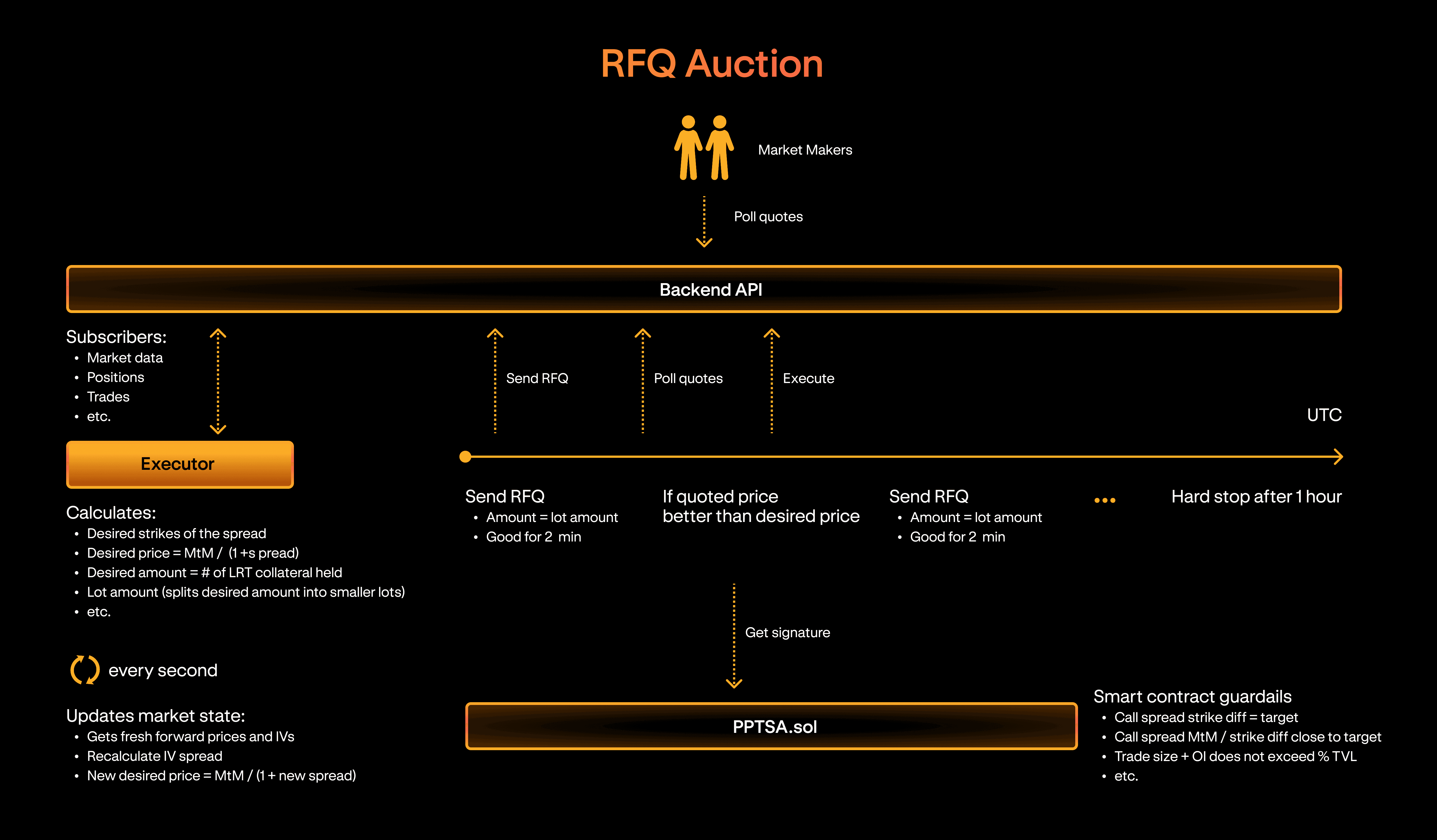
The vault begins to execute a ''RFQ auction'' to sell spreads.
Select a call spread from the desired expiry s.t. it's mark price is close to the target price.
The executor uses the orderbook API to find the spread of the target DTE that is closest to its target price.
The signing smart contract will validate that the DTE and the mark price of the option are within target range.
Calculate
desired_amountfor this spread, equal to the amount of collateral held. Split this amount into smaller ''lots'' (e.g., split 4000 weETH worth of desired size into 10 lots of size 400). These lots will be executed consecutively.Send a request-for-quote for this spread with size 400. Note that the RFQ automatically expires after 2 minutes and if not filled, a new one is sent.
Calculate
desired_pricefor this call spread. This is based on the forward price and volatility feeds from Block Scholes, and usesBlack76formula.Freeze for 15 seconds to allow market makers to send quotes.
Every second, recalculate
desired_priceusing fresh feeds and scale it down by a factor. Thedesired_pricethus gets progressively smaller until it hits a minimum after 2 minutes. The scaling factors equals1/(1 + mark_spread)wheremark_spread = min_since_lot_start * 0.5. In other words, after 2 minutes the vault'sdesired_priceis 50% of the mark price.Every second, compare the current best quote (across all market makers that sent them) to the
desired_price. Note that the RFQ system is a blind auction, namely market makers do not know other market makers' quotes. This prevents them from colluding and / or naively bidding the vault's worst possibledesired_price.If the price of the best quote is higher than the
desired_price, obtain a signature from the smart contract signer. If the transaction was successful, call the API to execute the quote.Keep re-creating new lots until the full desired amount is filled. Note that each new lot's desired_price is reset to mark price and goes down to 50% of the mark price over the lot's 2 minute lifespan.
Stage 3 - Await Option Settlement
After the order is fully filled or the hard stop has been reached, the executor will sleep until the option is expired and settled. After a settlement has been confirmed, the executor proceeds to stage 4.
Stage 4 - Collateral Limit Order Auction
Note that if the spread expired out-of-the-money, the vault will have positive USDC balance it acquired due from the premiums received in stage 2. If the spread expired ITM, the USDC balance can be positive or negative depending on if the premiums were enough to cover the settlement loss.
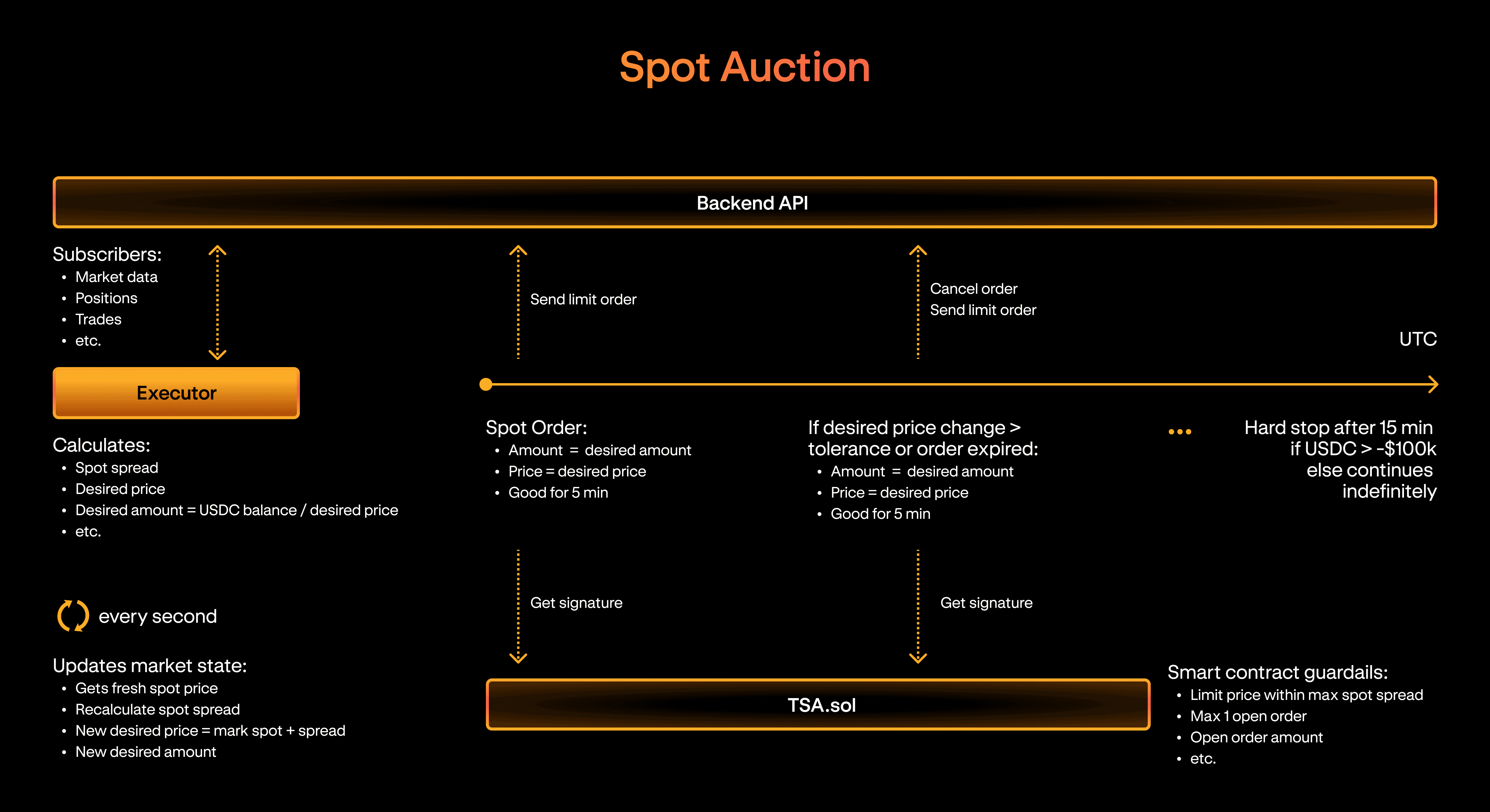
The vault then begins to execute a ''limit order auction'' to buy or sell enough collateral to get rid of any USDC balance and bring itself back to Stage 1.
Calculate
desired_pricefor the spot asset - this is based on the spot price oracle.Calculate
desired_amount = num of USDC / desired_price. For example, if the vault has $6,000 USDC and the LRT price is $3,000, the vault will attempt to buy 2 LRTs. Alternatively, if the vault has $30,000 USDC debt due to an option that expired ITM, it will attempt to sell 10 LRTs.Obtain a signature from the signing smart contract.
Send a limit order with the
limit_price = desired_priceandamount = abs(desired_amount). The order is a buy order ifdesired_amount > 0, otherwise it's a sell order.Every second, recalculate
desired_priceusing fresh feeds and add a small spread to the price (if buying) or subtract the spread (if selling). The spread is calculated asspot_spread = spot_spread_per_sec x (now - auction_start_sec), subject to amax_spot_spread. It is applied asdesired_price = (1 +/- spot_spread) x mark_spot.If desired price has changed by more than
spot_price_change_tolerance, cancel the old order, request a new signature, and send out a new order using the newdesired_priceanddesired_amount = remaining num of USDC / desired_price.Stop if
desired_amount = 0.If USDC balance is positive, hard stop when
(now - auction_start_sec)exceeds somemax_spot_auction_sec, e.g., 15 min. Note that it is possible for the auction to terminate and proceed back to stage 1 with some leftover USDC balance. If USDC balance is negative, the auction will continue indefinitely until the debt is repaid.The vault may allow some negligible amount of USDC debt to be left in the subaccount (in case this amount is difficult to get rid of due to orderbook minimum size restrictions or temporary liquidity problems).
Smart Contract Strategy Mandate Enforcement
The subaccount owned by the vault is registered with the Derive Exchange in the same way as a regular user, with the core difference being in the way the order signing is performed.
Derive ensures full custody of users' funds by requiring (at a smart contract level) that any trade between two parties has messages signed by their session keys. A session key is just a separate private / public key pair that the user gives trading permissions by registering it with Derive's matching smart contract.
For example, in order for a trade between Alice and Bob to take place (e.g., to sell 8 call options at a price of $12.5), both Alice and Bob must sign a message where they agree for such a trade, and both messages will be validated by the matching smart contract. Only the Exchange is allowed to submit such messages to the smart contract, which allows for added layers of security such as IP whitelisting of session keys, etc.
A vault has to go through the same flow, except the session keys it uses are not just plain old private keys stored somewhere secretly. Instead, the vault's session key is a smart contract, and signatures are generated by calling this contract's function.
The contract will only generate a signature if a set of validations passes, for example, it will check the requested RFQ execution amount against the TVL of the vault and refuses to generate a signature if the amount requested is too large. Similarly it will refuse to sign the RFQ execution if that price is too far away from an oracle price. The set of validations that the signer will run are as follows:
Ensure spread's mark price and expiry are within a certain target range
Ensure that at most one signed execution can at any time
Ensure that no order can be signed if USDC balance is too negative
Ensure that the amount in the execution does not exceed a % of TVL
Ensure that the amount of the spot order does not exceed what's required to clear the USDC balance
Ensure the spread trade price is higher than a threshold (calculated using oracle mark volatility and forward prices, then scaled down by a factor)
Ensure that the spot limit price is within a range from the oracle mark price
Ensure that the order signature will expire in < 10 min
This set of rules guarantees that the vault executor cannot trade outside of the vault's strategy mandate, and it protects the vault shareholders from badly prices trades being placed. At the same time, the off-chain components of the strategy (e.g., being able to cancel an open spot order when the price moves to avoid being picked off) enhances the execution quality.
Safe Harvest Risks
An overview of the key implementation risks of Covered Call Spread Tokens.
There are a few risks associated with tokenized strategies - beyond the risk of the strategy itself (detailed here). It is important users are aware of these risks before depositing to or acquiring a tokenized strategy. Note that this is not necessarily an exhaustive list.
Execution Risks
Delayed Settlement
If options expire in-the-money, collateral will need to be swapped for USDC on settlement. Available spot liquidity on the exchange and the amount of collateral to be liquidated could factor in to longer settlement times, in order to ensure quality of execution.
Oracle risks
Per the Derive docs, for each market, there is a set of oracle inputs used for marking assets when computing margin and liquidations. This data is posted onchain for transparency and available via the public REST API. This data is provided by Block Scholes.
It’s possible that feeds for certain assets (particularly less liquid ones) may have marks that deviate from the true fair value, which can result in suboptimal execution for the strategy vault.
Underlying Collateral Risk
Holding the underlying collateral carries its own set of risks. These may include, but are not limited to, smart contract bugs, Ethereum bugs, restaking penalties, price fluctuations, and key management problems.
For a detailed overview of the risks specific to each type of collateral, please refer to the relevant documentation:
LBTC Collateral:
Lombard's documentation & Babylon's documentation.
LRT Collateral:
EtherFi's documentation.
Swell's documentation.
Bridge Risk
Transferring assets from one network to another carries risks associated with the underlying bridge provider. In this product, we use Socket as the bridge provider. Please review their documentation for more details.
Smart Contract Risk
Interacting with any smart contract carries the risk of losing access to your funds. The immutable nature of smart contacts makes it difficult and potentially impossible to recover them.
Maxi Vaults
Maxi Strategy
An overview of the potential benefits and risks to participating in the Covered Put Spread Strategy
TLDR
Earn yield on the underlying collateral in "trending down", sideways or bull markets
The vault sells out-of-the-money (OTM) put options to generate the yield.
It simultaneously buys further OTM put options to limit downside risk in case of a large price drop.
How does the Covered Put Spread Strategy work?
A covered put spread is a trading strategy that involves holding the underlying asset as collateral while selling put spreads against it.
The automated Covered Put Spread Strategy consist of three main components:
Deposit the underlying asset as collateral into the vault.
Each week, the Vault will:
A. Sell OTM put options against it to earn yield; and
B. Buy further OTM put options to limit the downside risk in case of a large price drop.
After expiry, the Vault will either:
A. Buy collateral - If option settlement results in a positive USDC balance.
B. Sell collateral - If option settlement results in a negative USDC balance.
For a technical overview of how the Vault executes, please refer to the Covered Put Spread Execution article.
Why participate in the Covered Put Spread Strategy
The primary benefit of the Covered Put Spread Strategy is earning yield on the underlying asset by selling OTM put options (Strike K1).
To limit the downside risk, the strategy trades off a portion of the yield APY by also buying further OTM put options (Strike K2).
In the event the price drops significantly, the
max capped USDC loss = max(Strike K1 - Strike K2 - net premium received, 0).The strategy is best suited for holders of the underlying collateral who want to earn yield on their asset in a mildly bearish to very bullish market, while limiting the downside risk in case of a large price drop.
What are the risks of the Covered Put Spread Strategy?
The main risk of the Covered Put Spread Strategy is collateral conversion.
If the sold put spread expires ITM and the net premium received is not enough to cover the settlement loss, the Vault sells collateral to clear the USDC debt.
However, as mentioned before the max loss is capped in USDC terms (as described above)
For the implementation risks, please refer to Covered Put Spread Risks.
Example
Let's take LBTC as an example:
BTC price: $60,000
Collateral in the Vault: 100 LBTC, worth $6,000,000
The Vault sells 100 BTC put options with a $56,000 strike for $250 each and buys 100 BTC put options with a $54,000 strike price for $100 each.
Net premium received: $15,000.
Scenario 1:
BTC expires at $60,000
Both the short put options ($56,000 strike) and the long put options ($54,000 strike) expire OTM.
Breakdown:
Net Premium: +$15,000.
Short Put Options: $0 (expired OTM, worthless).
Long Put Options: $0 (expired OTM, worthless).
Total: +$15,000.
—> Vault buys 0.25 LBTC with the $15,000 to compound the yield.
—> Vault is up 0.25% in LBTC terms
Scneario 2: BTC expires at $55,900
The short put options ($56,000 strike) expire ITM and the long put options ($54,000 strike) expire OTM.
Breakdown:
Net Premium: +$15,000.
Short Put Options: -$10,000 ($55,900 - $56,000 * 100).
Long Put Options: $0 (expired OTM, worthless).
Total: +$5,000.
—> Vault buys 0.09 LBTC with the $5,000 to compound the yield.
—> Vault is up 0.09% in LBTC terms
Scenario 3:
BTC expires at $55,500
The short put options ($56,000 strike) expire ITM and the long put options ($54,000 strike) expire OTM.
Breakdown:
Net Premium: +$15,000.
Short Put Options: -$50,000 ($55,500 - $56,000 * 100).
Long Put Options: $0 (expired OTM, worthless).
Total: -$35,000.
—> Vault sells 0.63 LBTC to clear the $35,000 debt.
—> Vault is down 0.63% in LBTC terms
Scenario 4:
BTC expires at $52,000
Both the short put options ($56,000 strike) and the long put options ($54,000 strike) expire ITM.
Breakdown:
Net Premium: +$15,000.
Short Put Options: -$400,000 ($52,000 - $56,000 * 100).
Long Put Options: +$200,000 ($54,000 - $52,000 * 100).
Total: -$185,000 (note, the max USDC loss is always capped at $200,000).
—> Vault sells 3.56 LBTC to clear the $185,000 debt.
—> Vault is down 3.56% in LBTC terms
Maxi Execution
A technical explanation of how the Covered Put Spread Strategy executes
TLDR
Trades are executed on the Derive Exchange via RFQs (Request for Quote).
Vault sends out an intention to sell a put spread (request) and receives back responses from market makers (quotes). The Vault executes the best quote provided it's price is within the vault's desired range.
RFQ executions are signed by a smart contract that validates that the total amount of options sold does not exceed a % of the Vault's TVL, that the quote prices are within a reasonable distance from the oracle marks, and more.
At option expiry, the Vault will attempt to close out any USDC credit or debit by selling or buying its collateral on the Derive orderbook.
The vault only trades 7DTE expiries, and will select a spread that is closest to the target values. The target values are subject to adjustments if the asset price were to grow or fall significantly.
Vault Positions Lifecycle
The Vault positions go through the following stages:
Stage 1 - Only Collateral
The Vault launches with only its collateral and no positions. If the Vault collects option premiums and cannot sell the received USDC into collateral due to low liquidity, the Vault might also proceed to the next stage with a small amount of positive USDC balance (to be explained in Stage 4).
Stage 2 - Option RFQ Auction
Select a put spread from the desired expiry s.t. it's mark price is close to the target price.
The executor uses the orderbook API to find the spread of the target DTE that is closest to its target price.
The signing smart contract will validate that the DTE and the mark price of the option are within target range.
Calculate
desired_amountfor this spread, which is equal to the amount of collateral held.Split
desired_amountinto smaller ''lots'' (e.g., split 200 LBTC worth of desired size into 10 lots of size 20). These lots will be executed consecutively.Send a request-for-quote for this spread with size 20. Note that the RFQ automatically expires after 2 minutes and if not filled, a new one is sent.
Calculate
desired_pricefor this put spread. This is based on the forward price and volatility feeds from Block Scholes, and usesBlack76formula.Freeze for 15 seconds to allow market makers to send quotes.
Every second, recalculate desired_price using fresh feeds and scale it down by a factor. The
desired_pricethus gets progressively smaller until it hits a minimum after 2 minutes. The scaling factors equals1/(1 + mark_spread)wheremark_spread = min_since_lot_start * 0.5. In other words, after 2 minutes the Vault'sdesired_priceis 50% of the mark price.Every second, compare the current best quote (across all market makers that sent them) to the
desired_price. Note that the RFQ system is a blind auction, namely market makers do not know other market markers' quotes. This prevents them from colluding and / or naively bidding the Vault's worst possibledesired_price.If the price of the best quote is higher than the
desired_price, obtain a signature from the smart contract signer. If the transaction was successful, call the API to execute the quote.Keep re-creating new lots until the full desired amount is filled. Note that each new lot's
desired_priceis reset to mark price and goes down to 50% of the mark price over the lot's 2 minute lifespan.
Stage 3 - Await Option Settlement
After the order is fully filled or the hard stop has been reached, the executor will sleep until the option is expired and settled. After a settlement has been confirmed, the executor proceeds to Stage 4.
Stage 4 - Collateral Limit Order Auction
Note that if the spread expired out-of-the money, the Vault will have positive USDC balance it acquired due from the premium received in Stage 2. If the spread expired ITM, the USDC balance can be positive or negative depending on if the premiums were enough to cover the settlement loss.
The Vault then begins to execute a ''limit order auction'' to buy or sell enough collateral to get rid of any USDC balance and bring itself back to Stage 1.
Calculate
desired_pricefor the spot asset - this is based on the spot price oracle.Calculate
desired_amount = num of USDC / desired_price. For example, if the Vault has $120,000 USDC and the LBTC price is $60,000, the Vault will attempt to buy 2 LBTC. Alternatively, if the Vault has $600,000 USDC debt due to an option that expired ITM, it will attempt to sell 10 LBTC.Obtain a signature from the signing smart contract.
Send a limit order with the
limit_price = desired_priceandamount = abs(desired_amount). The order is a buy order ifdesired_amount > 0, otherwise it's a sell order.Every second, recalculate
desired_priceusing fresh feeds and add a small spread to the price (if buying) or subtract the spread (if selling).The spread is calculated as
spot_spread = spot_spread_per_sec x (now - auction_start_sec), subject to amax_spot_spread. It is applied asdesired_price = (1 +/- spot_spread) x mark_spot.If desired price has changed by more than
spot_price_change_tolerance, cancel the old older, request a new signature, and send out a new order using the newdesired_priceanddesired_amount = remaining num of USDC / desired_price.Stop if
desired_amount = 0.If USDC balance is positive, hard stop when
(now - auction_start_sec)exceeds somemax_spot_auction_sec, e.g., 15 min. Note that it is possible for the auction to terminate and proceed back to Stage 1 with some leftover USDC balance. If USDC balance is negative, the auction will continue indefinitely until the debt is repaid.The Vault may allow some negligible amount of USDC debt to be left in the subaccount (in case this amount is difficult to get rid of due to orderbook minimum size restrictions or temporary liquidity problems).
Smart Contract Strategy Mandate Enforcement
The subaccount owned by the Vault is registered with the Derive Exchange in the same way as a regular user, with the core difference being in the way the order signing is performed.
Derive ensures full custody of users' funds by requiring (at a smart contract level) that any trade between two parties has messages signed by their session keys. A session key is just a separate private / public key pair that the user gives trading permissions by registering it with Derive's matching smart contract.
For example, in order for a trade between Alice and Bob to take place (e.g., to sell 8 put options at a price of $250), both Alice and Bob must sign a message where they agree for such a trade, and both messages will be validated by the matching smart contract. Only the Exchange is allowed to submit such messages to the smart contract, which allows for added layers of security as IP whitelisting of session keys, etc.
A Vault has to go through the same flow, except the session key it uses are not just plain old private keys stored somewhere secretly. Instead, the Vault's session key is a smart contract, and signatures are generated by calling this contract's function.
The contract will only generate a signature if a set of validations passes, for example, it will check the requested RFQ execution amount agains the TVL of the Vault and refuses to generate a signature if the amount requested is too large. Similarly it will refuse to sign the RFQ execution if that price is too far away from an oracle price. The set of validations that the signer will run are as follows:
Ensure spread's mark price and expiry are within a certain target range.
Ensure that at most one signed execution can at any time.
Ensure that no order can be signed if USDC balance is too negative.
Ensure that the amount in the execution does not exceed a % of TVL.
Ensure that the amount of the spot order does not exceed what's required to clear the USDC balance.
Ensure the spread trade price is higher than a threshold (calculated using oracle mark volatility and forward prices, then scaled down by a factor).
Ensure that the spot limit price is within a range from the oracle mark price.
Ensure that the order signature will expire in < 10 min.
This set of rules guarantees that the Vault executor cannot trade outside of the Vault's strategy mandate, and it protects the Vault shareholders from badly prices trades being placed. At the same time, the off-chain components of the strategy (e.g., being able to cancel an open spot order when the price moves to avoid being picked off) enhances the execution quality.
Maxi Risks
An overview of the key implementation risks of the Covered Put Spread Strategy
There are a few risks associated with tokenized strategies - beyond the risk of the strategy itself (detailed here). It is important users are aware of these risks before depositing to or acquiring a tokenized strategy. Note that this is not necessarily an exhaustive list.
Stage 1 - Only Collateral
Execution Risks
Delayed Settlement
If options expire in-the-money, part of the underlying collateral will need to be swapped for USDC on settlement. Available spot liquidity on the exchange and the amount of collateral to be liquidated could factor in to longer settlement times, in order to ensure quality of execution.
Oracle Risks
Per the Derive docs, for each market, there is a set of oracle inputs used for marking assets when computing margin and liquidations. This data is posted onchain for transparency and available via the public REST API. This data is provided by Block Scholes.
It’s possible that feeds for certain assets (particularly less liquid ones) may have marks that deviate from the true fair value, which can result in suboptimal execution for the strategy vault.
Underlying Collateral Risk
Holding the underlying collateral carries its own set of risks. These may include, but are not limited to, smart contract bugs, Ethereum bugs, restaking penalties, price fluctuations, and key management problems.
For a detailed overview of the risks specific to each type of collateral, please refer to the relevant documentation:
LBTC Collateral:
Lombard's documentation & Babylon's documentation.
LRT Collateral:
EtherFi's documentation.
Swell's documentation.
Bridge Risk
Transferring assets from one network to another carries risks associated with the underlying bridge provider. In this product, we use Socket as the bridge provider. Please review their documentation for more details.
Smart Contract Risk
Interacting with any smart contract carries the risk of losing access to your funds. The immutable nature of smart contacts makes it difficult and potentially impossible to recover them.
BULL Vaults
BULL Strategy
TLDR
The BULL Strategy gives holders of yield-bearing assets (e.g., sUSDe and weETH) extra upside exposure to ETH without risking any of their initial capital.
If the ETH price increases by $100 or more in a week, holders can earn yields of up to 2.5x higher than the yield native to their asset.
If the ETH price remains stable, holders receive similar yields to the yield native to their asset.
If the ETH price declines by $100 or more, holders receive no yield for the week.
The strategy buys bull call spreads that are ‘around the money’ with the yield generated by the asset in the previous week. This gives users leveraged exposure to ETH on their yields.
The strategy performs best in a bull market, and outperforms in particular when the market grinds up.
The BULL Strategy is principal protected.
Supported Yield-Bearing Assets
The BULL Strategy currently supports the following yield-bearing assets as collateral:
Who should deposit?
This strategy is best suited to holders of these supported yield-bearing assets who are bullish ETH.
They will outperform and earn more yield during bull markets.
They will underperform and earn less/no yield during a bear market.
It is also suited to those who want (extra) upside exposure to ETH without risking any downside.
The most you can lose is the amount paid for the call spreads, which comes from the yield native to the asset.
What are the risks?
The key risk of this strategy is that you earn no yield on your asset if the market grinds down - that’s it!
What is a bull call spread?
A bull call spread is a simple trading strategy with two components:
A long call with strike K1
A short call with a strike K2 that is greater than K1
The maximum payout for a bull call spread is the difference between the two strikes (K2 - K1), which occurs when the price of the asset is at or above K2 on expiry.
The call spread expires worthless if the price of the asset is below K1 on expiry.
Example
You have $10,000 sUSDe earning 17% APY ($33.70 a week).
ETH = $3,500
K1 = $3,400
K2 = $3,600
Time to expiry: 7 days
In this example, the ETH 3,400 call is trading at $165, and the 3,600 call is trading at $70.
The sUSDeBULL strategy would buy 0.35x 3,400/3,600 call spreads which pay out if ETH rallies 3%+ in a week, and are roughly flat if ETH doesn’t move.
The cost of the call spread is $165 - $70 = $95.
The maximum the call spread can be worth on expiry is K2 - K1 = $3,600 - $3,400 = $200, which occurs when ETH is trading at $3,600 or higher.
The $3,400 and $3,600 calls are both worthless if ETH is below $3,400 on expiry.
If ETH is flat for the week and expires at $3,500, the call spread is worth $3,500 - $3,400 = $100, and the strategy makes a small profit of $5.
BULL Execution
Overview
The BULL vault (the Vault) executes a principal-protected strategy on the Derive Exchange. The vault will borrow USDC against the native yield accrued on Vault-held assets which will then be used to purchase ETH call spreads to potentially boost the yield.
Orders are signed by a smart contract that validates:
[Principal Protected] The total Value of yield-bearing assets held by the vault never decreases below the principal.
[Fair Pricing] Calls bought and sold are sufficiently close to mark prices.
All trades are conducted on the Derive Exchange. In particular:
Buying call spreads will take place via RFQ
Selling the yield-bearing asset to payoff USDC debt and buying the yield-bearing asset with winnings from the spreads will be done on the Orderbook.
When the call spreads expire
If the spreads are in-the-money (ITM), the Vault will be paid out USDC. This will payoff some or all of the USDC debt (borrowed against the yield-bearing asset principal to buy call spreads). Any residual USDC will be swapped into the yield-bearing asset.
If the spreads are out-of-the-money (OTM), an equivalent amount of the yield-bearing asset is sold via the OB to pay off the USDC debt.
The call spreads bought target a 2.5x boost. This means that the
mark_priceof the spread divided by thestrike_rangewill be 0.4. E.g. if thestrike_rangeis $50, themark_priceof the spread will be targeted to be $20.Parameters
expiry(e.g. weekly),mark_price / strike_range: 2.5xwill be further refined given Vault performance.
Call Spread Strategy
Step by step:
The Vault will hold all users’ deposited assets and earns the yield native to this asset.
Each week, the Vault will compute the yield generated from holding the asset. The Vault will then borrow an equivalent amount of USDC from the protocol.
The USDC will then be used to purchase, say, weekly 65/35 delta call spreads on ETH. That is, the Vault will purchase weekly call options closest to 65 delta and sell weekly call options closest to 35 delta.
The calls expire after one week.
Payoffs:
The calls are ITM: the Vault will receive a USDC payout from the purchased spreads. If there is still outstanding USDC debt, then an equivalent amount of the yield-bearing asset will be sold to pay off the debt (leaving the vault with only the yield-bearing asset).
The calls are OTM: An equivalent amount of the yield-bearing asset is sold to pay off all USDC debt, leaving the vault with only the yield-bearing asset.
The new week begins and the Vault will sell the previous week’s accrued yield native to the asset (i.e. ignoring the possible call spread profits) to fund the next round of spread purchases.
Example:
The Vault holds $10,000 of sUSDe and, over the course of week 0, earns $33.70 of sUSDe interest (~17% APY).
At the start of week 1, The Vault will borrow $33.70 of USDC from the protocol.
The Vault will purchase 0.35 x of the 3,400/3,600 weekly call spread. See sUSDeBULL strategy for more detail.
If ETH increases and the vault earns, say, $70 (max payout) from the spreads, all $33.70 of debt will be paid off and the remaining $66.30 USDC will be converted to sUSDe via the OB. Over week 1, the $10,000 sUSDe principal could have earned $23.78 (~12% APY). At the start of week 2, $23.78 will be used to purchase the next round of spreads.
Smart Contract Enforcement
The subaccount owned by the vault is registered with the Derive Exchange in the same way as a regular user, with the core difference being in the way the order signing is performed.
Derive ensures full custody of users’ funds by requiring (at a smart contract level) that any trade between two parties has messages signed by their session keys. A session key is just a separate private / public key pair that the user gives trading permissions by registering it with Derive's matching smart contract.
For example, in order for a trade between Alice and Bob to take place (e.g. to sells 8 call options at a price of $12.5), both Alice and Bob must sign a messages where they agree for such a trade, and both messages will be validated by the matching smart contract. Only the Exchange is allowed to submit such messages to the smart contract, which allows for added layers of security such as IP whitelisting of session keys, etc.
A vault has to go through the same flow, except the session keys it uses are not just plain old private keys stored somewhere secretly. Instead, the vault’s session key is a smart contract, and signatures are generated by calling this contract’s function.
The contract will only generate a signature if a set of validations passes, for example it will check the requested sell amount of sUSDe against the vault’s balance and refuse to generate a signature if the amount requested is too large. Similarly it will refuse to sign a price if that price is too far away from an oracle price. A complete list of contract safeguards will be added here shortly.
BULL Risks
There are a few risks associated with tokenized strategies - beyond the risk of the strategy itself (detailed here). It is important that users are aware of these risks before depositing to or acquiring a tokenized strategy. Note that this is not necessarily an exhaustive list.
Execution Risks
Per the Derive docs, for each market, there is a set of oracle inputs used for marking assets when computing margin and liquidations. This data is posted onchain for transparency and available via the public REST API. This data is provided by Block Scholes.
It’s possible that feeds for certain assets (particularly less liquid ones) may have marks that deviate from the true fair value, which can result in suboptimal execution for the strategy vault.
Underlying Collateral Risks
sUSDe: Holding sUSDe carries its own set of risks, including but not limited to smart contract bugs, Ethereum bugs, price fluctuations and key management problems. Please review Ethena's documentation for more details.
weETH: Holding weETH - a Liquid Restaking Token (LRT) - carries its own set of risks, including but not limited to smart contract bugs, Ethereum bugs, restaking penalties, price fluctuations and key management problems. Please review EtherFi's documentation for more details.
Bridge Risk
Transferring assets from one network to another carries risks associated with the underlying bridge provider. In this product, we use Socket as the bridge provider. Please review their documentation for more details.
Smart Contract Risk
Interacting with any smart contract carries the risk of losing access to your funds. The immutable nature of smart contacts makes it difficult and potentially impossible to recover them.
Smart Contracts & Audits
Smart Contracts
The contracts for the tokenized vault strategies have been audited by Sigma Prime. View the audit reports here.
Audits
The contracts for the tokenized vault strategies have been audited by Sigma Prime. View the audit reports here.
